

Overconsumption is a real issue for many people today. With the rise of Instagram influencers endlessly sharing Amazon links for the newest thing they are obsessed with, to targeted Ads on your social media pushing you to consume more, it is no wonder our homes are looking more like storage units than true living spaces.
Our world has evolved rapidly over the last 100 years, and our mental and emotional states are suffering the consequences. Rather than living simply, keeping only what we need, our homes are overflowing with stuff.
If you walked away from your home today and had to start from scratch, what would you replace? Many people would replace just the basics and a few mementos and keepsakes.
Studies have shown that clutter has a negative impact on our mental, emotional and even physical well-being, affecting focus, productivity, and sleep quality. It can cause feelings of shame, embarrassment and depression, and cause us to make poorer food choices and be less active.
So, how can this be fixed? By shifting our mindsets. Let’s start thinking of our homes as Living Spaces, rather than Storage Spaces. Sounds simple, right? It can be, with some practice to develop mindful living habits! Here are some techniques to help you shift your mindset:
Keeping it “just in case” vs. keeping something that supports your current life
At some point in time, everyone has been forced to decide to keep an item “just in case”. Some people are great at making quick decisions about what to do with the item, while others may struggle to develop a strong decluttering mindset. If you’re someone who struggles with these types of decisions, try asking yourself these questions:
- Is this something I use regularly or rarely?
- When was the last time I needed to replace this item (so when might be the next time I will need a replacement?)
- What will it cost to replace this item in the future if I don’t keep it?
- Do I have the space to store this, or is it taking up valuable living space or storage space for more important items?
Taking the time to answer these questions will ultimately help you let go of items you don’t need to be hanging on to.

Impulse buying vs. buying intentionally
In today’s society, we have everything we could ever wish for easily available. You don’t even need to leave the comfort of your own home to buy an item. With influencer marketing and online shopping readily available, it is easier than it has ever been to impulse buy items you don’t need with the click of a mouse.
Being intentional about our purchasing habits requires slowing down and taking the time to consider whether the item is useful and needed to make our lives better, or whether it will just add to the clutter.
A good way to do this is to “sleep on it”. If you feel yourself wanting to impulsively buy something, bookmark it and take a few days to think about it.
- Do you really need it?
- Will it be useful to you long-term?
- Will it be something you’ll want to use or wear six months from now?
Once you’ve considered these questions and given yourself a few days to think on it, see if you still feel as drawn to purchase it as you did before.
Storing duplicates vs. valuing extra space
Sometimes it makes sense to have duplicate items stored in your home. A few examples are consumables (toilet paper, toothpaste, medications, etc.), kitchen and household tools (can openers, cutting boards, light bulbs, batteries, etc.), linens (bedsheets, towels) and so on.
These items, however, usually take up minimal space and get used regularly. If you are storing extra small appliances, clothing, or furniture, it may be time to decide which you value more – the extra items, or the extra living space decluttering these items will allow for.
Holding on to old identities vs. letting go of clutter
Memories are important, and decluttering your home doesn’t mean getting rid of everything that doesn’t serve a daily purpose in your life, however, if you’re still hanging on to that old pair of jeans, hoping you will one day fit back into them, or to those tattered rock concert t-shirts you wore 25 years ago, it may be time to reconsider.
While you want to hang on to the memories attached to certain items, there are other, more practical ways to do it. You can take photos of items that evoke emotions or memories; create a memory box, or repurpose or upcycle the item into something more useful, like a quilt or pillow!
Minimalist Living & Organizing
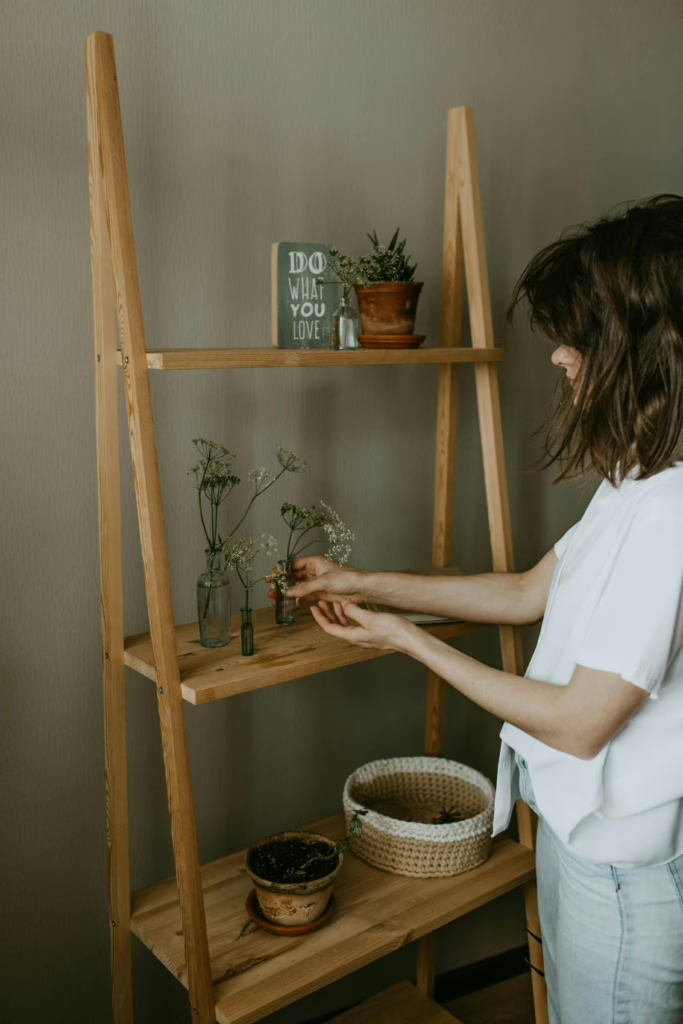
Some people may be scared off the idea of minimalist living, but to be clear, we’re not talking about paring down your home to just 50 items and sterilizing your environment by painting everything white. Minimalist living will look different for every family and every household. It simply means keeping the items that your family uses, and organizing them in a way that works for your home.